
PHOTO TOUR: HUMMINGBIRDS OF THE ATLANTIC FOREST
The Trochilidae family comprises around 300 species distributed throughout the Americas. Brazil ranks as the third country with the greatest diversity of hummingbirds in the world, home to approximately 89 species—surpassed only by Colombia and Ecuador.
The Atlantic Forest, one of the richest and most threatened biomes on the planet, serves as a crucial sanctuary for these birds, sheltering approximately 45 recorded species in the region. One of the biome’s greatest highlights is the presence of endemic species—birds that evolved exclusively in this region and cannot be found anywhere else on Earth.

A Small Biome, An Enormous Diversity
The Atlantic Forest once stretched continuously from Rio Grande do Norte to Rio Grande do Sul. Today, only fragments remain—in many regions, less than 10% of the original forest cover—but even these patches of forest are still among the most biodiverse environments on the planet. Researchers have catalogued more than 200 bird species endemic to the biome, and hummingbirds are among the best-represented groups on that list.
The explanation lies in the vegetation. Small areas of preserved forest support a remarkable variety of plants with tubular flowers—wild banana plants, bromeliads, fireweeds—shaped over millions of years to fit precisely with the bill of a particular hummingbird species. It is such a precise example of coevolution that, in some cases, a flower’s design exists only because a specific bill has evolved to reach it.

Brazilian Ruby
Masters of Flight, Surprising Physiology, and Pollination
Hummingbirds are remarkable little creatures, most weighing between 2 and 6 grams. Yet their tiny size conceals an impressive range of anatomical and physiological abilities:
Unique Flight Architecture
They are the only birds capable of hovering motionless in midair, flying backward, and even flying upside down! Their wings can beat up to 80 times per second, moving in a figure-eight pattern that generates continuous lift.
Accelerated Heart and Metabolism
A hummingbird’s heart accounts for about 5% of its total body weight and can reach an astonishing 1,200 beats per minute.
Daily Energy Consumption
To sustain this pace, they visit up to 2,000 flowers a day (taking a break every 10 to 15 minutes), consuming a volume of nectar that often exceeds their own body weight. In addition to nectar, they also hunt small insects to obtain protein.
Energy-Saving Mechanism (Torpor)
When temperatures drop or food becomes scarce, hummingbirds enter a state of torpor—a form of temporary hibernation in which their body temperature and heart rate drop dramatically to conserve energy.
Adapted Bills and Coevolution
Each species has a bill shape and length adapted to specific flowers found in native vegetation, such as bromeliads, orchids, and heliconias.
Iridescent Plumage
The shimmering colors of their feathers are not due solely to pigments, but also to the microscopic structure of the feathers, which refracts sunlight and creates vivid shades of green, blue, purple, and red depending on the observer’s angle.

Why Do They Matter So Much?
Hummingbirds are more than just a visual spectacle. In the Atlantic Forest, they are responsible for pollinating more than 400 species of native plants—many of which have no other effective pollinator. By feeding on nectar dozens of times a day, they carry pollen between flowers across considerable distances, ensuring the reproduction of plant species that support the entire surrounding food web. Losing an endemic hummingbird species can also mean losing the plant that depends exclusively on it.
That is why forest fragmentation is such a serious threat: when a forest corridor is broken, some species avoid crossing open areas. Reforestation projects, the conservation of private nature reserves, and the creation of native gardens are essential for reconnecting these populations.
Main species occurring along the route
Among the winged gems that delight visitors during our expeditions through the Atlantic Forest, we have the chance to photograph:
Saw-billed Hermit (Ramphodon naevius)
Brazilian Ruby (Heliodoxa rubricauda)
Frilled Coquette (Lophornis magnificus)
Festive Coquette (Lophornis chalybeus)
Ruby-topaz Hummingbird (Chrysolampis mosquitus)
Scale-throated Hermit (Phaethornis eurynome)
Swallow-tailed Hummingbird (Eupetomena macroura)
Glittering-bellied Emerald (Chlorostilbon lucidus)

Festive Coquette


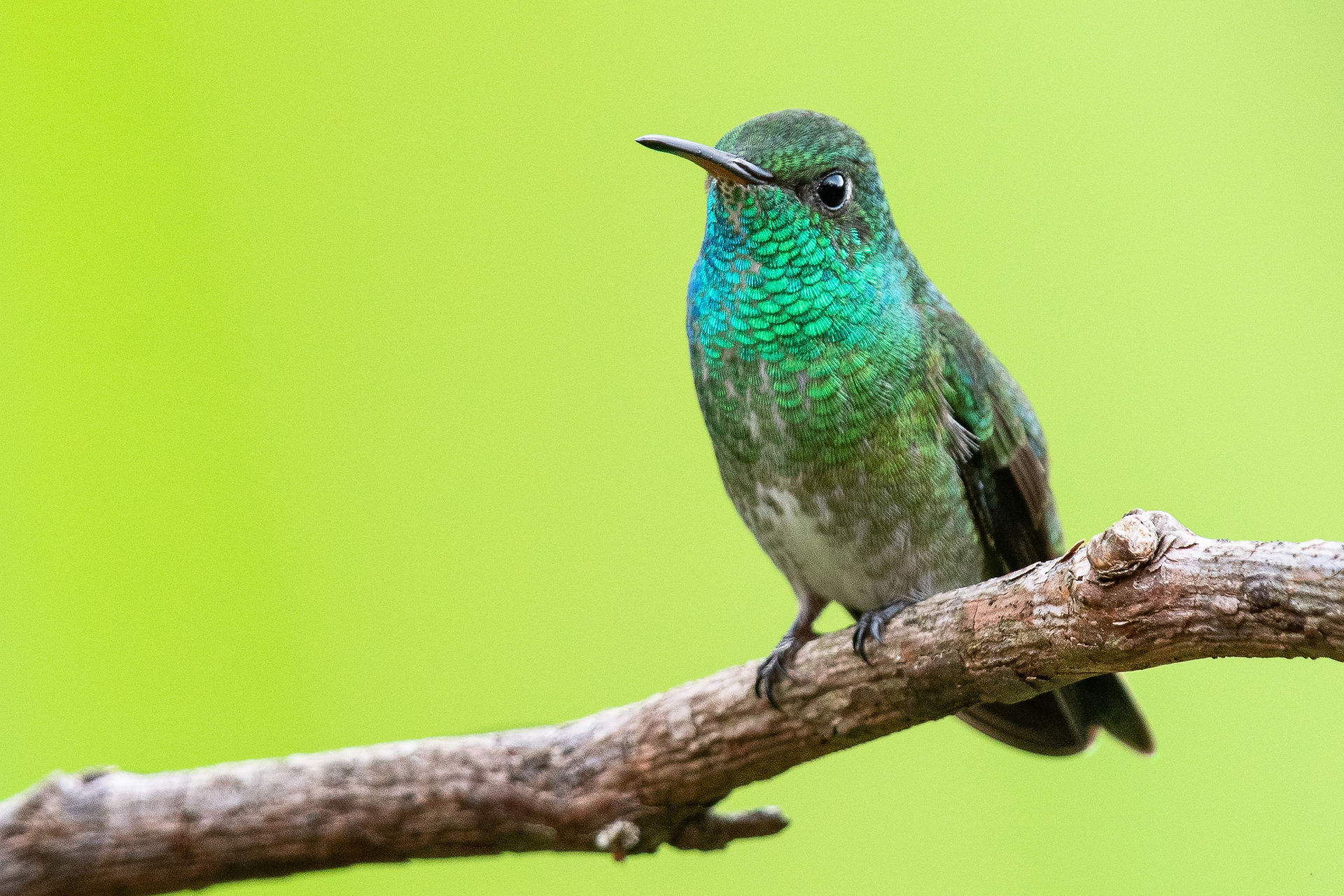


As well as several other species such as the White-chinned Sapphire, Green-crowned Plovercrest, Sombre Hummingbird, Versicolored Emerald, Black-eared Fairy, Ruby-topaz Hummingbird, Sapphire-spangled Emerald, Reddish Hermit, Black Jacobin, White-vented Violetear, Stripe-breasted Starthroat, Rufous-throated Sapphire, Blue-chinned Sapphire, Black-throated Mango, and the White-throated Hummingbird.
Where and How to Observe Hummingbirds Responsibly
The best way to see a high number of hummingbird species in a short period of time is to visit specialized birding lodges and private reserves, where feeders and gardens are specifically designed to attract hummingbirds at close range. These locations are ideal both for birdwatchers who simply want to enjoy observing these remarkable birds and for photographers interested in high-speed hummingbird photography.
When observing and photographing hummingbirds, remember to:
Respect a safe minimum distance from the birds.
Avoid using direct flash toward the birds' eyes.
Choose tour operators and local guides who are committed to conservation and ethical birdwatching practices.
Get your camera ready!
Capturing the swift flight, vibrant colors, and extraordinary beauty of hummingbirds in their natural habitat is one of the most rewarding experiences in wildlife tourism in Brazil.
👉 Check out the full itinerary, visiting some of the top lodges dedicated to bird photography in Southeastern Brazil:
Contact the Birds Atlantic team to request a personalized quote and check upcoming available dates!
👉 Request your personalized quote: Click here

Comments